The Wheel of Life
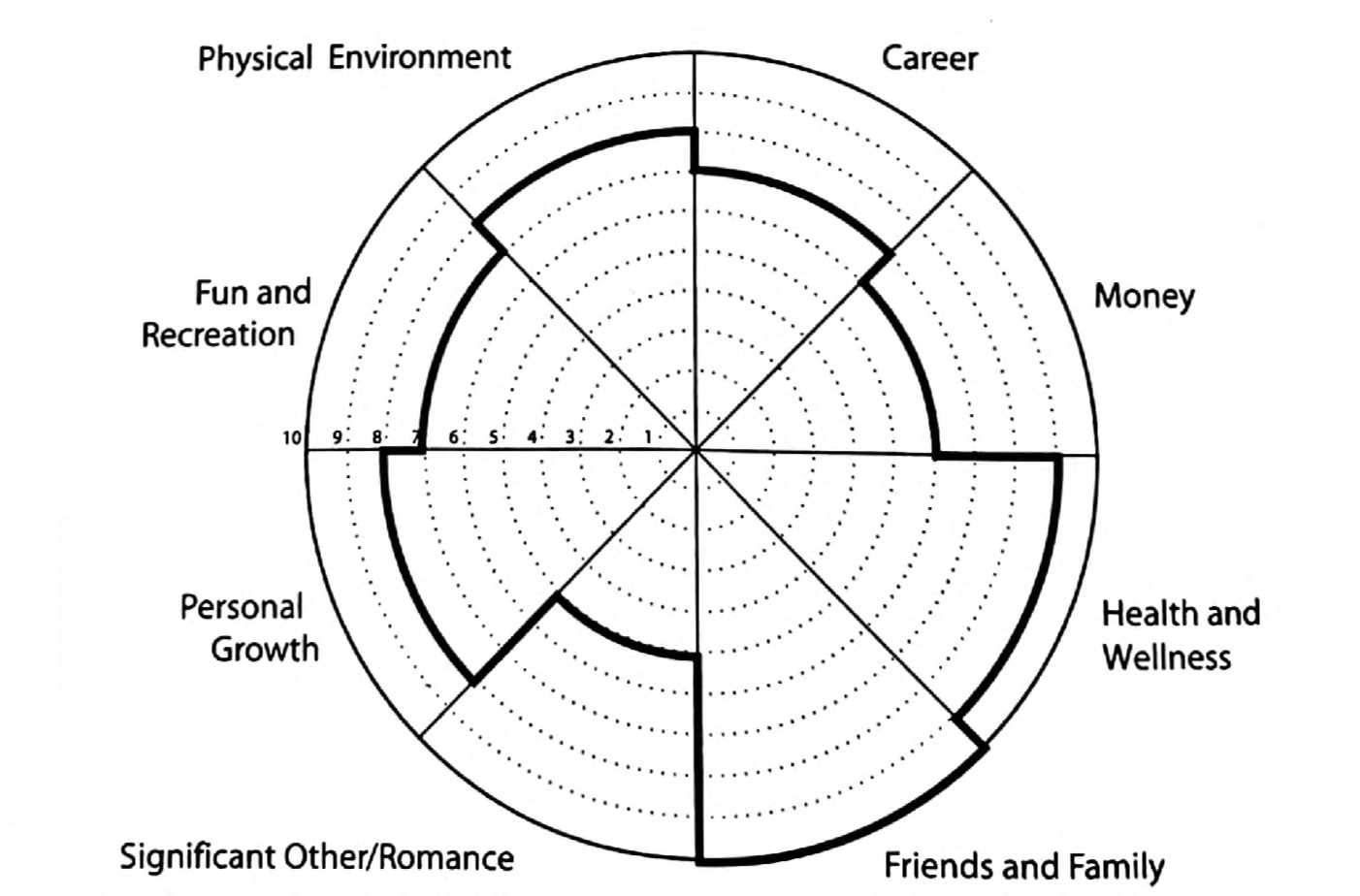
The Wheel of Life is a widely used self-reflection tool in coaching and psychology. It offers a holistic view of how you’re currently experiencing different areas of your life, and more importantly, where there’s room for growth, rebalancing, or healing.
Step 1: Identify the Core Areas of Your Life
To begin, choose 8–10 life domains that are meaningful to you. These are typically areas where people seek balance and fulfillment. Common ones include:
- Career or Purpose
- Finances
- Health & Physical Well-being
- Romantic Relationships
- Family & Social Connections
- Personal Growth or Education
- Emotional or Mental Health
- Fun, Play & Creativity
- Spirituality or Inner Peace
- Home or Environment
The categories should reflect your values and lifestyle. If something feels irrelevant, replace it with a dimension that matters more in your current season of life.
Step 2: Rate Your Current Satisfaction
On a scale from 0 (completely dissatisfied) to 10 (deeply fulfilled), rate how you currently feel in each area — not how you think you should feel.
Try not to judge the numbers. This is an observational exercise, not a performance review. Honesty will serve you better than optimism here.
Step 3: Create Your Wheel
Draw a circle and divide it into slices — one for each life area. Mark your ratings outward from the center (0 in the middle, 10 at the edge), then connect the points to create a shape.
This shape becomes a visual representation of your current balance— or imbalance. A smooth, rounded wheel implies stability; a jagged or uneven shape may suggest friction or areas being neglected.
Step 4: Reflect on What You See
Ask yourself:
- Which areas are getting the most of my time and energy?
- Which areas feel neglected or undernourished?
- What surprised me about this exercise?
- What one shift would make the biggest difference in how I feel day-to-day?
This stage is crucial. Insight is the bridge between awareness and change.
Step 5: Set Meaningful Intentions
Now, select 1–3 areas that you'd like to shift or improve. Set specific,achievable goals for each. These don’t have to be big — the key is consistency and intention.
Examples:
- Instead of “Get healthier,” → “Schedule one therapy session this month.”
- Instead of “Be more social,” → “Reach out to one friend each week.”
These small actions can create meaningful momentum.
Step 6: Revisit and Realign
Life is fluid, and so is the Wheel of Life. Reassess every 1–3 months.Look for changes, new insights, or patterns. Celebrate progress, even if it’s incremental.
Remember: sustainable change is often quiet and slow. Give yourself the same compassion you’d extend to someone you care for.
Final Thoughts from a Psychologist’s Lens
The Wheel of Life is more than a visual, it’s a structured invitation to pause, reflect, and realign your daily actions with your deeper values. It’s especially useful during transitions, burnout recovery, or when life simply feels “off.”
If you feel consistently stuck in one or more areas, consider exploring that further with a coach or therapist. Often, stuckness is not about lack of effort, it’s about unseen internal blocks that deserve a safe space to be unpacked.
Schedule your free consultation today
Whether you’re seeking therapy or coaching, Dr. Poe is here to guide you toward meaningful growth and transformation. Start your journey today.

FAQs
Find answers to commonly asked questions about our services, including session durations, costs, and what to expect.
Still have questions? Contact me.
The primary difference between therapy and coaching lies in their focus, goals, methods, and the qualifications of the professionals providing these services. Choosing between therapy and coaching depends on your current needs and circumstances. If you're unsure, contact me and we can discuss this further.
Therapy is a collaborative process where individuals work with a trained therapist to address mental health concerns, develop coping strategies, and achieve personal growth. It can involve exploring emotions, behaviors, and thought patterns.
Coaching is a collaborative process where a trained professional helps individuals identify and achieve personal and professional goals. It is forward-looking and centered around growth, empowerment, and actionable steps.
Look for a coach with experience in your industry who has expertise in your area of concern. You should look at their training and experience. You should feel a connection with the person, like their style, and feel genuinely heard. Listen to your intuition here.Education and training are also important. As a clinical psychologist and a business coach I am able to draw from a range of theories (outside of coaching) to creatively conceptualize your issues through multiple lenses.
Yes, online therapy or phone calls are as effective as in person therapy. I have studio quality audio and visual equipment to provide an experience that is optimal and natural for you.There was sufficient evidence to support VTC and telephone-delivered interventions…[have the same effectiveness as in person therapy],… for mental health conditions.
Yes, studies on coaching outcome have supported improvements in communication skills, self-efficacy and intentionality in making and holding boundaries for young scientists time and energy. A meta-analyses of studies on executive coaching found improvements in self-efficacy, psychological capital, and resilience indicating executive coaching is effective in producing change even on dimensions considered relatively stable over time.
Psychotherapy is effective for 75% of individuals.The general or average effects of psychotherapy are widely accepted to be significant and large, (Chorpita et al., 2011; Smith, Glass, & Miller, 1980; Wampold, 2001). These large effects of psychotherapy are quite constant across most diagnostic conditions and most types of therapy. Variations in outcome are more heavily influenced by patient characteristics e.g., chronicity, complexity, social support, and intensity-and by clinician and contextual factors, than by particular diagnoses or specific treatment “brands,” (Beutler, 2009; Beutler & Malik, 2002a, 2002b; Malik & Beutler, 2002; Wampold, 2001).